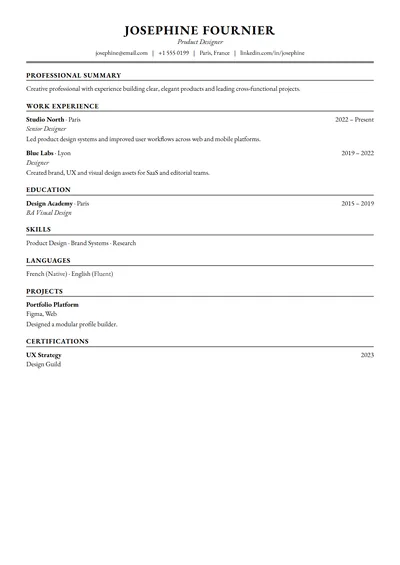
Harvard Style
ClassicCentred Garamond header with a double rule — the Ivy League finance standard.
Use this templateTemplate guide
The high-density format used in management consulting and banking recruiting. One page, a serif name over a burgundy rule, employers listed first with your title in italics beneath, and dates right-aligned so the page reads as a tidy grid.
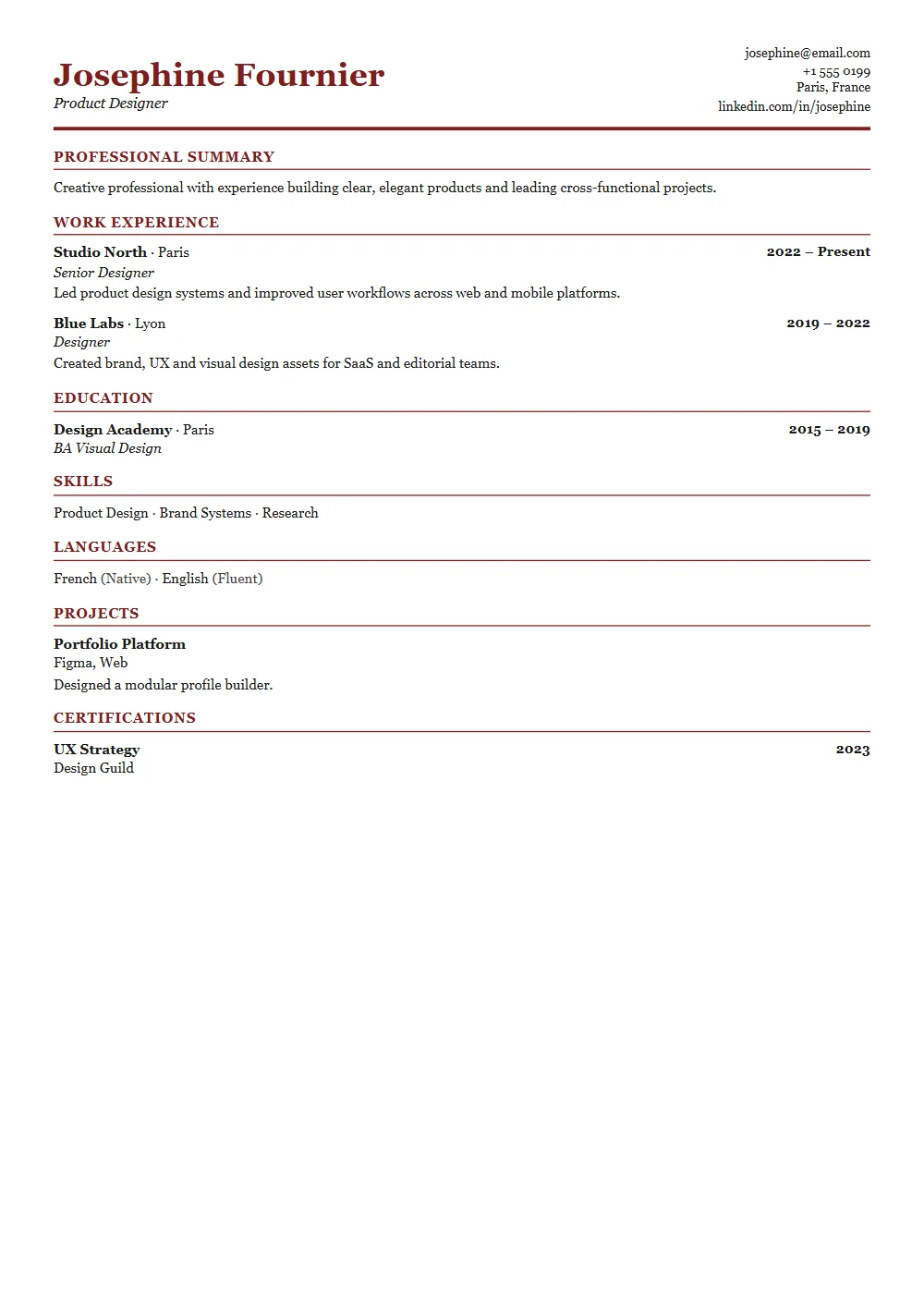
Firms screen hundreds of resumes per role, against the same few signals: academic strength, quantified impact, leadership, and what consultants call a "spike", one thing you are clearly exceptional at. The format puts these where a screener looks: education at the top for students, employers in bold, and results in every bullet.
Each bullet is a small case: what you did, how, and the measurable result.
Built a pricing model across 2,400 SKUs that raised gross margin 3.2 points in two quarters.
Led a team of 4 analysts on a cost diagnostic; client adopted 11 of 14 recommendations, saving $18M a year.
Avoid "responsible for" and "assisted with". If you cannot put a number on it, show scale instead: team size, budget, number of markets or users.
For students and MBA candidates, Education comes first, with test scores or honours if they are strong. Experienced hires put Experience first. End with a short Additional line: languages, technical skills and two or three genuine interests. Interviewers do ask about them.
Consulting and banking applications expect one page. No exceptions until you are very senior.
Three close alternatives, and every one carries your content across untouched when you switch.
Centred Garamond header with a double rule — the Ivy League finance standard.
Use this template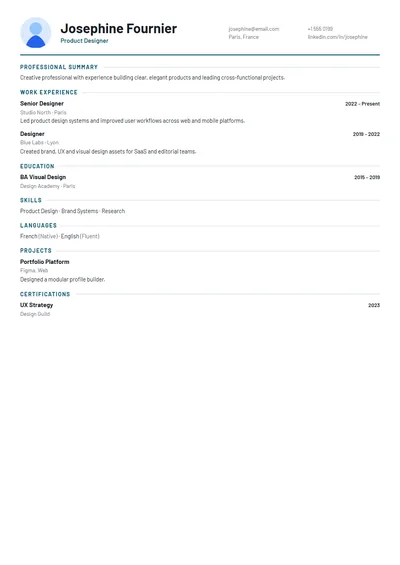
High-density single page for long careers that must still fit one sheet.
Use this template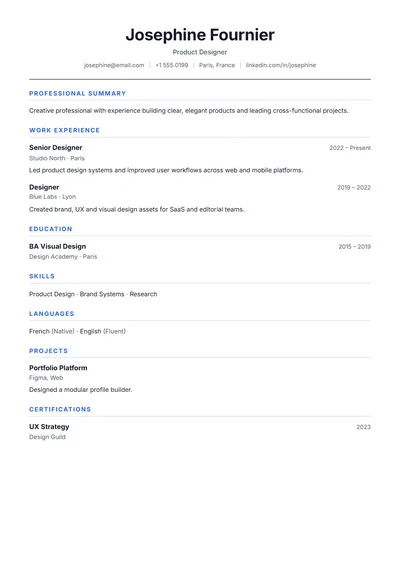
A genuinely simple resume: centred name, hairline rules, one column. Nothing to distract, nothing to break.
Use this templateFAQ
A one-page, single-column resume with education, experience and an additional section, where every bullet shows a quantified result. This template follows that convention.
Usually not for students and MBA candidates; the space is better used for results. Experienced hires can add a two-line summary.
If they are strong, yes, on the education line. Consulting screens weigh academic performance heavily, especially for graduate hires.
Yes. Banking resumes use the same dense, one-page, employer-first format.